Need A Custom Solution?
Our team is filled with seasoned experts who can't wait to help you find the right solution for your business.

Whatsapp: +86 177 3218 7602

E-mail: info@ccwirecloth.com

In practical applications, brass mesh is frequently used for air filtration, protective guards for machinery, speaker grilles, and decorative partitions. Thanks to its golden metallic luster, brass mesh is often the preferred choice for projects where aesthetics are a priority. As application environments become increasingly complex, the corrosion resistance of brass mesh has emerged as a critical factor determining its service life. So, is brass mesh corrosion-resistant, and what factors influence this resistance? This article analyzes the subject by examining material composition, corrosion mechanisms, and actual operating environments.
Brass wire mesh is a metal mesh product made from high-quality brass wire through precision weaving or welding. Brass wire mesh can be manufactured using different grades such as H62, H65, H70, and H80, and is available in various weaving structures, including plain weave, twill weave, Dutch weave, to meet different customers' requirements for mesh precision, strength, transmittance, and filtration performance.
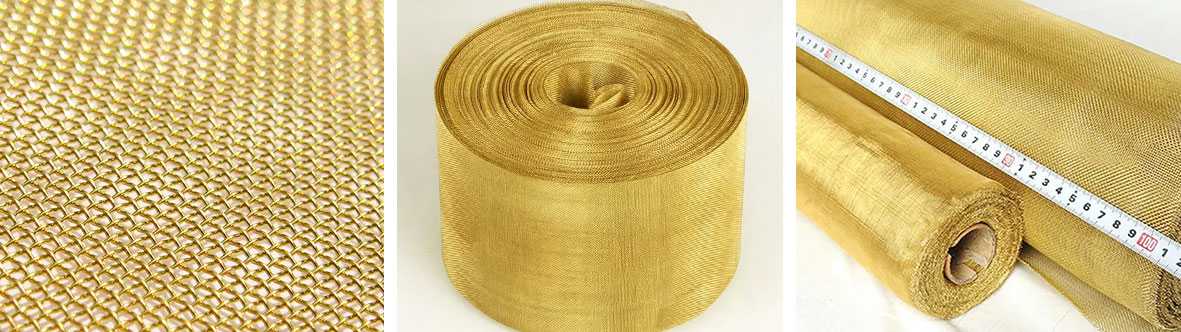
Brass wire mesh has good wear resistance, ductility, and dimensional stability. It can be further processed through shearing, punching, bending, and welding to easily create filter discs, filter cartridges, screens, decorative meshes, protective meshes, and other deep-processed products. Furthermore, due to the electromagnetic shielding properties of brass, brass wire mesh is also commonly used in electronic equipment, electromagnetic shielding covers, and radio frequency interference protection.
In practical applications, brass mesh is widely used in industrial filtration, oil and gas filtration, chemical screening, building decoration, door and window protection, electronic shielding, handicrafts manufacturing, and home decoration.
Brass is an alloy material with copper and zinc as its main components. It has good mechanical strength, corrosion resistance, electrical and thermal conductivity, and excellent processing performance.
Copper is a key factor influencing the corrosion resistance of brass. Copper possesses inherent chemical stability; upon exposure to air and moisture, a protective oxide film gradually forms on its surface. This film reduces direct contact between the metal and the external environment, thereby slowing the rate of further oxidation.
In ordinary atmospheric conditions, brass mesh does not typically develop red rust as rapidly as standard steel materials. Instead, it undergoes gradual color changes over time—such as a loss of surface luster, a deepening of color, or even the formation of green oxides. These phenomena are part of the natural oxidation process of copper alloys and do not indicate immediate material failure.
The addition of zinc primarily serves to enhance the hardness, strength, and workability of brass, facilitating the drawing and weaving of brass wire into structurally stable metal mesh.
In terms of corrosion resistance, zinc is chemically active; in certain environments, it may preferentially dissolve, leading to a phenomenon known as dezincification. Prolonged exposure to seawater, high-salinity mist, or acidic environments causes a gradual loss of zinc, altering the material's internal structure and resulting in issues such as reduced strength and surface degradation.
Brass Wire Mesh Material Composition Table | ||
| Composition | Content Range | Main Function |
| Copper (Cu) | Approx. 60%–70% | The primary component of brass wire mesh, providing good electrical conductivity, ductility, and corrosion resistance. |
| Zinc (Zn) | Approx. 30%–40% | Improves hardness, strength, wear resistance, and processing performance. |
| Lead (Pb) | Usually ≤3% | Enhances machinability and improves manufacturing efficiency during processing. |
| Iron (Fe) | Trace amount | Improves mechanical strength, wear resistance, and structural stability. |
| Tin (Sn) | Trace amount | Enhances corrosion resistance and improves performance in certain harsh environments. |
| Other Trace Elements | Small amount | Adjusts alloy properties, such as strength and heat resistance, depending on the brass grade. |
The corrosion resistance of brass mesh stems primarily from two factors:
In natural environments, copper reacts slowly with oxygen and moisture, forming substances such as copper oxide and basic copper carbonate on its surface. These substances coat the metal, creating a relatively stable protective layer that slows the rate of corrosion.
Alloying copper with zinc enhances the material's overall properties. Compared to pure copper, brass offers superior strength and wear resistance; compared to ordinary steel, it exhibits better oxidation resistance, allowing it to maintain good stability in typical operating environments.
In dry, well-ventilated indoor environments, brass mesh exhibits good corrosion resistance. Due to the low presence of corrosive agents, a protective oxide layer gradually forms on the brass surface, slowing down further corrosion. With long-term use, the mesh may undergo minor oxidation—such as darkening or a reduction in luster—but this generally does not affect its structural integrity.
Typical Applications:
● Interior decorative mesh
● Display racks
● Electromagnetic shielding mesh
● Decorative craft materials
In prolonged humid conditions, a film of moisture forms on the brass surface, accelerating oxidation and compromising the stability of the protective layer.
This May Result in:
● Darkening of the surface color
● Loss of lustre
● Localized oxidation
However, brass mesh still corrodes more slowly than ordinary steel mesh. For long-term use, its service life can be extended through coatings, protective treatments, or regular maintenance.
In seawater or high-salt-spray environments, chloride ions can compromise the protective film on the brass surface and accelerate dezincification, leading to a reduction in the material's strength and toughness.
This May Result in:
● Embrittlement of the mesh wires
● Reduced strength
● Corrosion-induced perforation
In practical applications, brass mesh is unsuitable for long-term use in seawater or high-salt-spray environments; 316 stainless steel mesh or seawater-resistant alloys are recommended for such scenarios.
Acidic Environments: Long-term use is not recommended
Acidic media can damage the protective layer on the brass surface and accelerate metal dissolution, particularly compromising the stability of the zinc component. Prolonged Exposure to Strongly Acidic Environments May Result in:
● Accelerated corrosion
● Loss of surface luster
● Reduced strength
Therefore, the use of brass mesh in strongly acidic industrial environments for extended periods is not recommended.
Brass mesh exhibits a certain degree of stability in mildly alkaline environments; however, the risk of corrosion increases in highly concentrated or high-temperature alkaline environments.
When used in applications such as chemical solutions or cleaning equipment, the appropriate material should be selected based on the specific properties of the medium.
Different types of metal mesh exhibit varying levels of corrosion resistance due to their distinct material compositions.
Corrosion Resistance Comparison of Different Wire Mesh Materials | ||
| Material | Corrosion Resistance | Main Characteristics |
| 316 Stainless Steel Mesh | Excellent | Highly resistant to salt water, chemicals, and harsh corrosive environments. |
| 304 Stainless Steel Mesh | Good | Excellent overall performance with balanced corrosion resistance, strength, and durability. |
| Copper Mesh | Good | Excellent electrical conductivity with good corrosion resistance and thermal performance. |
| Brass Mesh | Moderate | Attractive golden appearance, easy processing, good machinability, and cost-effective performance. |
| Galvanized Steel Mesh | General | Provides initial rust protection through zinc coating, but the coating may wear or fail over time. |
| Mild Steel Mesh | Poor | High strength and low cost, but prone to rust and corrosion without additional surface treatment. |
Stainless steel mesh, containing chromium, forms a dense protective oxide layer on its surface, resulting in strong corrosion resistance; notably, 316 stainless steel—enriched with molybdenum—performs exceptionally well in seawater and chloride-rich environments.
Copper mesh, owing to its high copper content and chemical stability, generally offers superior corrosion resistance compared to brass mesh; however, its lower hardness means it may not be the optimal choice for applications requiring high strength or wear resistance.
Brass mesh combines copper and zinc to enhance material strength and workability while maintaining a degree of corrosion resistance and offering a distinctive golden-yellow appearance. Its advantage lies not in corrosion resistance alone, but in a balanced overall performance profile encompassing corrosion resistance, strength, ease of processing, and aesthetic appeal.
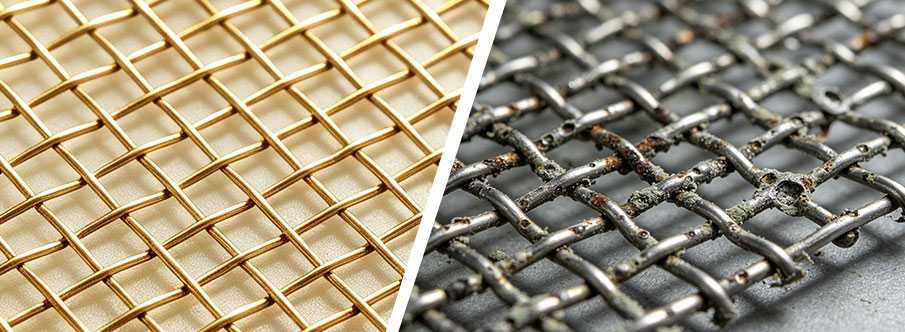
● Compared to stainless steel mesh, brass mesh offers better processing flexibility and a more distinctive appearance.
● Compared to pure copper mesh, brass mesh boasts higher strength and better wear resistance, making it a type of metal wire mesh product that balances practicality and decorative appeal.
● Compared to standard steel or galvanized steel mesh, brass mesh offers greater stability against corrosion; however, in environments such as seawater, areas with high salt-spray exposure, or conditions involving strong acids or alkalis, its service life may still be compromised by "dezincification" (the leaching of zinc).
In summary, brass mesh is a material with above-average corrosion resistance, making it suitable for standard conditions, mildly humid environments, and applications where appearance and workability are priorities. For highly corrosive environments, however, materials with superior corrosion resistance—such as 316 stainless steel—should be selected.
Corrosion resistance varies among different grades of brass.
Generally Speaking
● Higher copper content results in superior corrosion resistance;
● Higher zinc content increases hardness but reduces corrosion resistance.
Therefore, the specific material composition should be considered when selecting brass mesh.
Thicker wire generally offers:
● A longer service life regarding corrosion resistance;
● Higher mechanical strength.
While fine-wire brass mesh provides high filtration precision, it is more prone to breakage after undergoing corrosion.
Different surface treatments affect the corrosion resistance of brass mesh. Common factors include:
● Forms a stable protective film on the surface, slowing oxidation and corrosion rates while enhancing corrosion resistance.
● Adds a protective layer to improve surface wear resistance and corrosion resistance.
● Reduces direct contact between the brass and air, moisture, or corrosive media, thereby extending service life.
● Reduces surface defects and the adhesion of contaminants, minimizing the occurrence of localized corrosion.
Consequently, the quality and method of surface treatment directly impact the brass mesh's oxidation resistance and long-term performance.
The corrosion resistance of brass mesh is determined by a combination of its material composition and the operating environment. In dry air and typical indoor settings, brass mesh generally exhibits good stability because the copper content allows for the formation of a protective oxide film; however, in humid environments, moisture accelerates oxidation and increases the rate of corrosion. Furthermore, in environments involving seawater, salt spray, or strong acids and alkalis, corrosion resistance drops significantly, as chloride ions and acidic or alkaline media compromise the protective layer and destabilize the zinc component.
Therefore, a definitive answer regarding the corrosion resistance of brass mesh cannot be given in isolation; instead, the specific application environment must be considered. Only by selecting a material suited to the environmental conditions can the performance advantages of brass mesh be fully realized.
As an experienced Chinese brass mesh manufacturer, Hebei Cechen New Material Co., Ltd. specializes in producing high-quality brass wire mesh for industrial filtration, screening, protection, and decorative applications. Our brass mesh is manufactured using premium brass wire materials, with options including different wire diameters, mesh counts, aperture sizes, weaving patterns, roll widths, and sheet dimensions to meet various application requirements.
With advanced weaving equipment and professional production capabilities, we provide customized brass mesh solutions according to customers’ working environments and performance requirements. Our customization services include:
● Customized brass wire diameter and mesh specifications
● Different weaving types, including plain weave and twill weave
● Customized roll and sheet sizes
● Cutting, stamping, and deep processing services
● OEM solutions for industrial and decorative applications
With years of wire mesh manufacturing experience and global export capabilities, we are committed to providing reliable brass mesh products for customers worldwide in industries such as filtration, electronics, architecture, and industrial protection.
About Our | |
| Item | Details |
| Manufacturer | Hebei Cechen New Material Co., Ltd. |
| Location | Anping, Hebei, China |
| Experience | 40+ years of wire mesh manufacturing |
| Products | Brass wire mesh, copper mesh, stainless steel mesh |
| Customization | Wire diameter, mesh size, roll width, stamping, cutting |
| Applications | Filtration, screening, decoration, shielding |
| Export Markets | North America, Europe, Asia, and global markets |
Previous:
None
Next:
Applications of Stainless Steel Mesh in Filtration and Screening
Rencent News

Is Brass Mesh Corrosion-Resistant?
Aug. 03, 2026

Applications of Stainless Steel Mesh in Filtration and Screening
Jul. 29, 2026
Contact Us
Hello, welcome to submit any questions and suggestions. We will reply to you as soon as possible. Thank you for your support and help.
Need A Custom Solution?
Our team is filled with seasoned experts who can't wait to help you find the right solution for your business.
Get In Touch
Whether you have a question about our products or services, or simply want to learn more about what we do,we are always here to help.