Need A Custom Solution?
Our team is filled with seasoned experts who can't wait to help you find the right solution for your business.

Whatsapp: +86 177 3218 7602

E-mail: info@ccwirecloth.com

Stainless steel wire mesh is widely used in industrial filtration, screening, food processing, chemical processing, and many other applications. Among the available materials, 304 and 316 stainless steel mesh are two common choices. Although both grades belong to the austenitic stainless steel family, they differ in chemical composition and corrosion resistance. Understanding these differences can help engineers, purchasing professionals, and equipment manufacturers choose a suitable stainless steel mesh for their operating conditions.
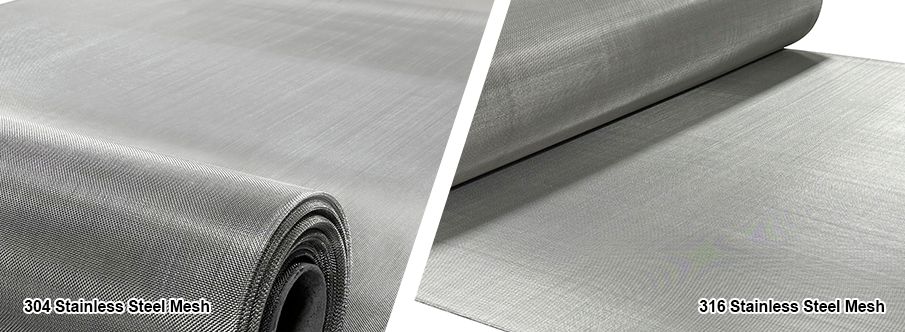
In this guide, we will examine the properties of 304 and 316 stainless steel wire mesh, explain their main differences, and discuss the factors to consider when selecting a mesh for industrial applications.
304 stainless steel wire mesh is a woven or welded mesh product manufactured from 304-grade stainless steel wire. As an austenitic stainless steel, Grade 304 typically contains 18–20% chromium and 8–10.5% nickel, with the balance primarily iron. Its combination of corrosion resistance, formability, and mechanical properties makes it one of the most widely used materials for industrial wire mesh.
The chromium content enables the formation of a thin, protective passive oxide layer on the steel surface. This layer helps resist oxidation and corrosion in many atmospheric and industrial environments. However, its performance depends on the surrounding conditions, particularly exposure to chlorides, aggressive chemicals, and elevated temperatures.
In wire mesh manufacturing, 304 stainless steel can be processed into different mesh counts, wire diameters, aperture sizes, and weave patterns. Plain weave is commonly used for general screening and filtration, while other weaving configurations may be selected to meet specific requirements for opening size, mechanical performance, or flow characteristics.
Typical applications include industrial filtration, particle screening, food processing equipment, architectural mesh, and protective screens. For applications involving frequent chloride exposure or highly corrosive media, the suitability of 304 stainless steel should be evaluated carefully before selection.
316 stainless steel wire mesh is manufactured from 316-grade stainless steel wire and is commonly selected for applications requiring enhanced resistance to localized corrosion. It is also an austenitic stainless steel, typically containing 16–18% chromium, 10–14% nickel, and 2–3% molybdenum, with the balance primarily iron.
The main distinction between 316 and 304 stainless steel is the addition of molybdenum. This alloying element improves resistance to pitting and crevice corrosion in many chloride-containing environments, making 316 stainless steel a useful option for more demanding industrial applications.
Like 304, Grade 316 can be woven or processed into mesh products with different wire diameters, mesh counts, opening sizes, and weave structures. The final mesh specification affects filtration performance, open area, and mechanical behavior, so material selection should be considered alongside the required mesh construction.
316 stainless steel wire mesh is commonly used in chemical processing equipment, marine-related components, industrial filtration, and certain water treatment applications. However, it is not immune to corrosion in seawater or highly aggressive chemical environments. Chloride concentration, temperature, surface condition, and exposure duration should all be considered when determining whether 316 stainless steel is suitable for a particular application.
The main difference between 304 and 316 stainless steel wire mesh lies in their chemical composition, particularly the molybdenum content in Grade 316. This difference affects corrosion resistance in certain environments, but it does not mean that 316 is automatically the better choice for every application.
| Comparison | 304 Stainless Steel Mesh | 316 Stainless Steel Mesh |
| Main alloy elements | Chromium and nickel | Chromium, nickel, and molybdenum |
| Typical chromium content | 18–20% | 16–18% |
| Typical nickel content | 8–10.5% | 10–14% |
| Corrosion resistance | Suitable for many general environments | Improved resistance to chloride-related pitting and crevice corrosion |
| Typical applications | General screening, food processing equipment, protective mesh | Chemical processing, marine-related equipment, demanding filtration |
| Relative cost | Generally lower | Generally higher |
Note: Composition ranges are typical values. Actual requirements depend on the applicable material standard and product specification.
● Both grades rely on a passive surface layer to resist corrosion. However, their performance differs under certain environmental conditions.
● 304 stainless steel wire mesh is suitable for many general industrial applications, but prolonged exposure to chlorides or aggressive chemicals may increase the risk of localized corrosion.
● 316 stainless steel mesh generally provides better resistance to chloride-induced pitting and crevice corrosion. This makes it worth considering for applications where salt exposure or corrosive liquids are a concern.
● Neither grade is completely corrosion-proof. The final choice should account for chemical concentration, operating temperature, surface condition, and exposure time.
● The strength and performance of stainless steel wire mesh depend on more than the material grade. Wire diameter, mesh count, aperture size, weave pattern, and manufacturing quality also influence the finished product.
● For filtration applications, these factors affect particle retention, open area, and flow characteristics. For screening applications, mechanical strength and dimensional stability may be more important.
● When comparing 304 and 316 stainless steel mesh, it is therefore important to evaluate the material grade together with the required mesh specifications.
● 316 stainless steel wire mesh generally costs more than comparable 304 mesh because of its alloy composition and raw material costs.
● For applications involving relatively mild conditions, 304 may provide a practical balance between cost and performance. Where improved resistance to localized corrosion is required, the additional cost of 316 may be justified.
● The actual price also depends on mesh count, wire diameter, weave type, dimensions, order quantity, and any additional processing requirements.
Selecting the right stainless steel mesh starts with understanding the operating environment and the intended function of the mesh.
● Operating conditions: Identify whether the mesh will be exposed to moisture, chlorides, saltwater, cleaning agents, or industrial chemicals.
● Mesh specifications: Confirm the required mesh count, wire diameter, aperture size, weave pattern, and product dimensions.
● Filtration requirements: Consider particle retention, flow rate, operating pressure, and cleaning methods. Mesh count alone does not determine the actual opening size or filtration performance.
● Mechanical requirements: Evaluate the expected load, wear, deformation risk, and required service life.
● Long-term costs: Compare the initial purchase price with expected maintenance, replacement frequency, and operating conditions.
For example, 304 stainless steel mesh may be suitable for general-purpose screening, while 316 may be a better candidate for certain filtration applications involving chloride-containing liquids. More aggressive environments may require additional corrosion assessment or consideration of alternative materials.
After identifying the appropriate material grade, selecting a qualified stainless steel wire mesh manufacturer is another important step.
When evaluating a manufacturer, consider the following factors:
● Material verification: Confirm the stainless steel grade and ask whether material test certificates or other relevant documentation are available.
● Manufacturing capabilities: Check whether the manufacturer can produce the required mesh count, wire diameter, aperture size, weave pattern, and dimensions.
● Quality control: Ask how dimensional accuracy, weaving consistency, and surface condition are inspected.
● Customization: Confirm whether special dimensions and technical specifications can be manufactured to meet your application requirements.
Providing complete technical details when requesting a quotation helps reduce misunderstandings and makes it easier to compare products from different suppliers.
The main difference is chemical composition. 316 stainless steel contains approximately 2–3% molybdenum, which improves its resistance to pitting and crevice corrosion in many chloride-containing environments. 304 stainless steel is generally more economical and suitable for many general-purpose applications.
Yes. Stainless steel wire mesh can develop rust-like stains or localized corrosion under certain conditions, including chloride exposure, chemical contamination, and unsuitable operating environments. Choosing the appropriate grade and maintaining a clean surface can help reduce corrosion risks.
Not necessarily for every outdoor application. 304 stainless steel mesh can perform well in many inland environments with ordinary weather exposure. For coastal areas, salt spray, or other chloride-rich conditions, 316 stainless steel mesh is often a more suitable choice because of its improved resistance to localized corrosion.
No. A magnet is not a reliable method for distinguishing 304 from 316 stainless steel. Both grades are generally non-magnetic in the annealed condition, although wire drawing and weaving can introduce some magnetic response. Material certificates, traceability, and appropriate material testing are more reliable ways to verify the grade.
No. The material grade does not directly determine filtration fineness. Both 304 and 316 stainless steel wire mesh can be manufactured with different mesh counts, wire diameters, and aperture sizes. Filtration performance depends on the mesh construction and the requirements of the complete filtration system.
It depends on the operating environment. In general industrial applications with limited chloride exposure, 304 stainless steel mesh may provide sufficient corrosion resistance at a lower cost. Where chloride-related corrosion is a concern, 316 may offer better long-term value by reducing the risk of premature deterioration. The decision should consider both the initial price and expected service conditions.
The main difference is carbon content. Standard 316 stainless steel typically permits a maximum carbon content of 0.08%, while 316L has a maximum of 0.03%. The lower carbon content of 316L helps reduce the risk of sensitization during welding or other elevated-temperature processing, making it a common choice for welded or fabricated assemblies where corrosion resistance near welds is important.
Start by specifying the required grade and applicable material standard when placing an order. Request material test certificates or other traceability documentation where available. If independent verification is necessary, professional chemical analysis or positive material identification (PMI) can help confirm the alloy composition. Visual appearance alone is not sufficient to identify the grade reliably.
304 and 316 stainless steel wire mesh are widely used in industrial applications, but their suitability depends on the operating environment and required performance. 304 stainless steel mesh is a versatile option for many general-purpose applications. 316 stainless steel mesh, with its molybdenum content, generally provides improved resistance to chloride-related pitting and crevice corrosion.
Before selecting a product, consider the material properties, mesh construction, operating conditions, and long-term costs. Working with an experienced stainless steel mesh manufacturer can help ensure that the selected material and specifications meet the requirements of the intended application.
Rencent News
Contact Us
Hello, welcome to submit any questions and suggestions. We will reply to you as soon as possible. Thank you for your support and help.
Need A Custom Solution?
Our team is filled with seasoned experts who can't wait to help you find the right solution for your business.
Get In Touch
Whether you have a question about our products or services, or simply want to learn more about what we do,we are always here to help.